
Moundsville Address History Sources
Previous residents leave different kinds of dated traces. A deed names parties to a land transfer. A directory may associate a householder with a printed address. A census records a household on its enumeration date, while probate or an obituary can explain why a name leaves the trail. Start with the source whose date is closest to the period under study, then work both backward and forward.
| Source | Years It Covers | Where Held | What It Shows |
|---|---|---|---|
| Recorded deeds and indexes | Key archive series begin in 1835; present files continue with the Clerk | Marshall County Clerk, IDX, WV Archives | Grantor, grantee, legal description, book/page and prior reference |
| Pruden's city directory | 1899-1900 catalog lead | FamilySearch catalog and local library inquiry | Dated name and address associations where an entry exists |
| Reverse or criss-cross volumes | Exact local runs not verified | Moundsville-Marshall County Public Library | Address-to-householder or telephone clues |
| Federal census | Released after 72 years | Library genealogy databases and federal access routes | Household composition and neighborhood sequence on the census date |
| Probate, wills, and appraisements | Archive series begin in 1835 with varying end dates | County Clerk and WV Archives | Estate relationships, property descriptions, appraisals, and distributions |
| Permits and public city files | Specific coverage not published | Moundsville Building Inspection or City Clerk request | Work at an address and the named project role |
For a recent address history, begin with the current assessment and deed reference. For the nineteenth or early twentieth century, begin with the legal description and archive series rather than expecting a modern street number to appear.
Start Moundsville History by Parcel
The parcel ID is more stable than a street label. Search the WV Property Assessment Search for Marshall County and record the current owner result, situs address, owner mailing address, deed book/page, legal description, assessment year, and GIS ID. Mailing and situs fields must remain separate. An assessment owner is not proof that the person occupied the building.
The assessor search provides the official controls used to establish that starting point.
Open the parcel in GIS to confirm its shape and adjacent land. If the online assessment seems stale, the Marshall County Assessor is the correction contact and its Map Room maintains ownership and plat records.
Trace Marshall County Owners Backward
The deed chain supplies the backbone for a search for previous residents. Begin with today's recorded reference, not just the assessed name. Every transfer should preserve the parties, instrument date, book and page, legal description, and any reference to an earlier deed. Moundsville town-lot searches use district choices labeled Moundsville in Clay and Moundsville in Washington, so copy the subdivision language exactly.
- Copy the current deed book/page and legal description from the assessor detail.
- Find that instrument in the Marshall County Clerk index. Read the seller, or grantor, and all prior references.
- Search the seller as a grantee to locate that party's earlier purchase. Match the land by legal description, not name alone.
- Repeat one transfer at a time, keeping an evidence log. Mark gaps, spelling variants, and changes in lot wording.
- When the web index or scanned books stop, request the volume/page at the Clerk's office or use the named archive and microfilm series.
- Grantor / grantee
- The grantor transfers an interest; the grantee receives it.
- Chain of title
- The linked sequence of recorded transfers for the same land.
- Legal description
- The lot, block, boundary, or metes-and-bounds text that identifies land even when its street address changes.
- Criss-cross directory
- A directory arranged by address or telephone number, useful for finding a dated householder.
Moundsville Deeds Online and Offline
The Marshall County Clerk links IDX Document Search, Image Search, and scanned land books. Search computers at the office are another route. The portal uses an account and payment workflow for image printing or downloads, while the listed archive series extend the deed trail well beyond what a convenient current screen may show.
The Clerk page is the official starting point for recorded land, probate, election, and vital records.
Do not guess an online cutoff year. The WV Archives inventory specifically lists deeds from 1835 through 1901 and an index to deeds, leases, and related records from 1835 through 1971. Those holdings are finding aids, not a promise that each page can be opened online.
Moundsville Records Begin in 1835
Marshall County formed in 1835, the practical opening of its courthouse trail. The WV Archives Blue Note lists wills beginning in 1835, deed and related indexes beginning in 1835, trust-deed grantor indexes from 1872, appraisement series beginning in 1835, and survey books from 1836. The first Moundsville courthouse served from 1836 to 1875, and the current courthouse opened in 1876.
The WV Archives inventory is shown here:
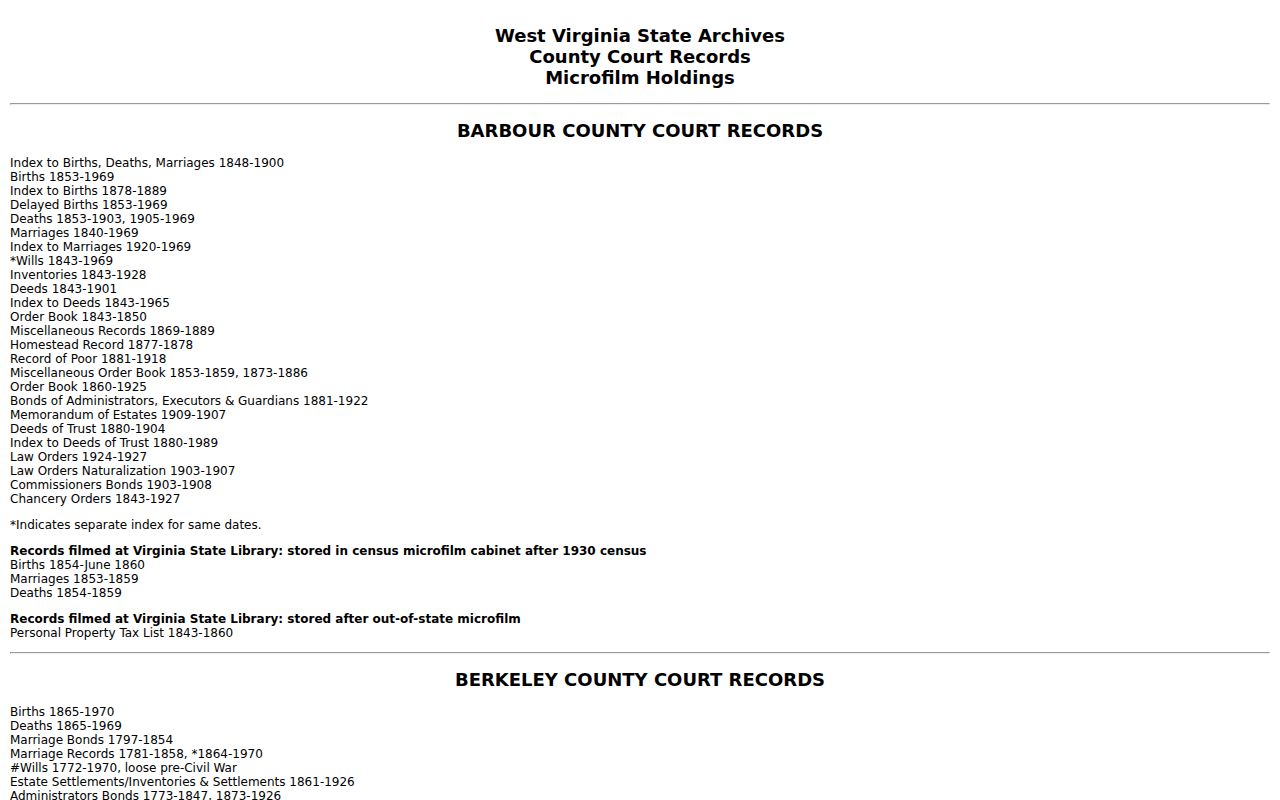
No official source reviewed for Moundsville documented a courthouse fire or total reconstruction loss. Gaps must be described by the actual series and dates, never explained with a stock local-history story.
| Archive trail | Listed span |
|---|---|
| Deeds | 1835-1901 |
| Deeds, leases, and related index | 1835-1971 |
| Wills / wills index | 1835-1930 / 1835-1971 |
| Appraisement and related estate index | 1835-1950 |
| Survey books | 1836-1878 |
Moundsville Directories Fill Occupant Gaps
Deeds track ownership, not every person who lived at a place. The strongest verified local directory lead is Pruden's Moundsville title for 1899-1900 in the FamilySearch catalog. Exact reverse-directory runs were not verified. Ask the Moundsville-Marshall County Public Library staff which address-based volumes, yearbooks, maps, and local newspaper files are actually available before planning a visit.
The Moundsville library provides a catalog, the Echo newspaper archive, Ancestry Library, and FamilySearch affiliate tools.
Some genealogy tools may require a library computer. The collections and how to read an entry are treated in depth on the Moundsville city directories page.
Insider tip. Bring the 1899-1900 Pruden's catalog citation and ask staff for exact local runs by year and format.
Verify Old Moundsville Street Numbers
No complete, official Moundsville renumbering or renaming chronology was found. That gap matters when a directory address seems to vanish. Preserve the old printed form. Compare it with a dated deed description, city map, ordinance, postal item, and GIS parcel, then state which source supports the bridge. A modern ZIP or standardized spelling should never overwrite a historical transcription.
Moundsville's standard delivery ZIP is 26041, but USPS delivery geography does not prove a parcel lies within city limits. Likewise, an owner mailing address may point away from the parcel. Legal description and parcel ID are better anchors for the land itself.
Moundsville Probate Closes the Trail
When a deed chain ends with an estate, turn to County Clerk probate records. Wills, fiduciary appointments and bonds, appraisements, settlements, distributees, and estate claims can connect property to heirs or explain a later transfer. The historical inventory includes wills and indexes, appraisement records, fiduciary bonds, and estate-distribution material with distinct year ranges. Request by decedent, approximate date, estate identifier, and record series.
Newspaper death notices and the Echo archive can add family or community context. A vital index can confirm an event lead, but a certificate follows separate access rules. Birth records become public after 100 years, while death, marriage, divorce, and annulment records become public after 50 years, with protected sections excluded. Earlier access requires statutory eligibility or authorization.
Pair Moundsville Households by Date
Past residents appear most clearly when independent dated sources agree. A city directory supplies an entry near a certain year. A census can identify the household on its fixed enumeration date and show nearby households in sequence. A deed confirms ownership, not occupancy. An obituary or probate file may explain a death, family tie, or move, but it should retain its own citation.
- Transcribe the directory year, page, address, and name exactly as printed.
- Locate the closest publicly released census and note the enumeration district, page, household, and date.
- Compare names and ages without forcing a match. Search spelling variants and the Elizabethtown name for evidence predating the 1866 consolidation.
- Check the deed owner for that period, then label owner and occupant separately if they differ.
- Add newspaper, vital, or probate evidence only with its source date and access limits.
An omission from one directory is not proof that nobody lived there. Publishers missed households, volumes covered selected areas, and exact Moundsville runs remain a research question. Previous residents may surface in the next volume or in a census taken between editions.
Lawful use. Research previous residents for house history, genealogy, or a lawful estate matter. Never use it to locate, monitor, harass, or harm a living person.